Seminars
Short seminars for clinicians, health researchers, policymakers and students on how data science can improve health.
View events
Data science for health in East Africa
Data Science for Health Discovery and Innovation in Africa (DS-I Africa).
About
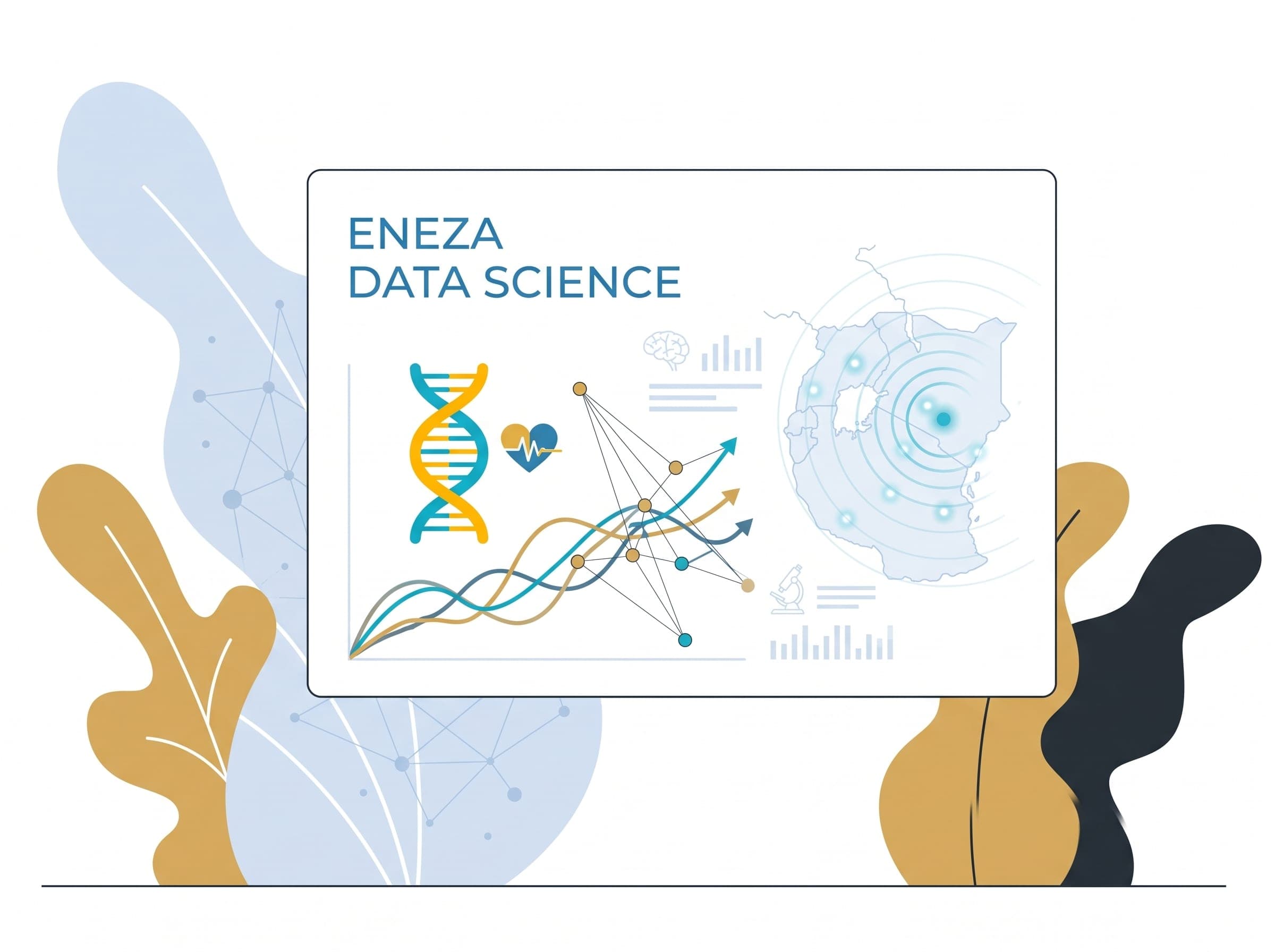
Eneza is a Swahili word meaning “spread” or “disseminate.” The programme, Eneza Data Science: Enhancing Data Science Capability and Tools for Health in East Africa, works to improve health for mothers and children at risk, and mental health for adolescents and young adults at risk in Kenya.
It builds on the bioinformatics research and training of H3Africa, The Eastern Africa Network for Bioinformatics Training (EANBiT), and H3ABioNet, the pan-African bioinformatics network.
The team brings together machine learning and artificial intelligence, clinical practice, statistics, bioinformatics, and infectious-disease expertise. Eneza is a short training and internship path that builds data science skills and helps researchers and clinicians work together on communicable and non-communicable diseases in the region.
Coming up
No upcoming events right now.
Programmes
Short seminars for clinicians, health researchers, policymakers and students on how data science can improve health.
View eventsWorkshops for clinicians and researchers on how to collect and manage health data. Clinicians and researchers learn the tools used to collect data.
View eventsResidential training that builds data science skills for clinicians and health skills for data scientists and ends with a small group project.
View eventsA six-month health data science internship for recent graduates, built around mentoring and real projects.
View eventsProfiles

Medical doctor. Head of Division for Digital Health in Kenya’s Ministry of Health, in the Directorate of Digital Health, Informatics, Research and Policy. He is leading the rollout of a mobile health system based on network analysis, and the shift from data collected for reporting to data used for action.

Physician-scientist. His work is on health policy and innovation, using machine learning and deep learning to improve access, quality, and efficiency, especially where resources are limited. He develops AI tools that help clinicians tailor care to each patient. His work is supported by the NIH and Veterans Affairs.

Bioinformatician at the International AIDS Vaccine Initiative and adjunct lecturer at Pwani University. He holds a BSc in Biotechnology from Kenyatta University, and an MSc and PhD in Bioinformatics from Rhodes University. He previously led bioinformatics at icipe. He is a board member of the Open Bioinformatics Foundation and Dryad, and works on open science, reproducible genomics, capacity building, and data management.